
Abdominal Aorta Ultrasound: How AAA Screening Works
Reviewed by the Fairbanks Ultrasound imaging team · Updated October 2026
An abdominal aorta ultrasound is a quick, painless scan that measures the width of the aorta, the body’s largest artery, to check for an abdominal aortic aneurysm (AAA). An AAA is a bulge in the aorta that measures 3.0 cm or larger. Most aneurysms cause no symptoms until they rupture, which is why screening matters. The U.S. Preventive Services Task Force (USPSTF) recommends a one-time ultrasound screening for men ages 65 to 75 who have ever smoked.
At Fairbanks Ultrasound, the abdominal aorta is evaluated as part of our abdominal ultrasound in Fairbanks, AK and our vascular ultrasound services. This guide explains what the test checks, who should consider screening, and what your results mean.
What Is an Abdominal Aortic Aneurysm (AAA)?
The aorta carries blood from your heart down through your chest and abdomen. In the abdomen, it is usually about 2 cm across in adults. When a section of the wall weakens and widens to 3.0 cm or more, it is called an abdominal aortic aneurysm.
Most AAAs grow slowly and cause no symptoms. The danger is rupture. If a large aneurysm bursts, it causes severe internal bleeding, and the USPSTF reports that the risk of death after rupture is as high as 81%. Screening finds aneurysms early so they can be measured, monitored, and repaired before they reach a dangerous size.
Get in touch with us!
Who Is at Risk for an AAA?
The USPSTF lists these as the most important risk factors:
- Age 65 or older
- Male sex
- A history of smoking, the strongest predictor of AAA and its growth
- A parent, sibling, or child with an AAA, which roughly doubles the risk
Other risk factors include other aneurysms, coronary artery disease, cerebrovascular disease, atherosclerosis, high cholesterol, and high blood pressure.
How Does an Abdominal Aorta Ultrasound Work?
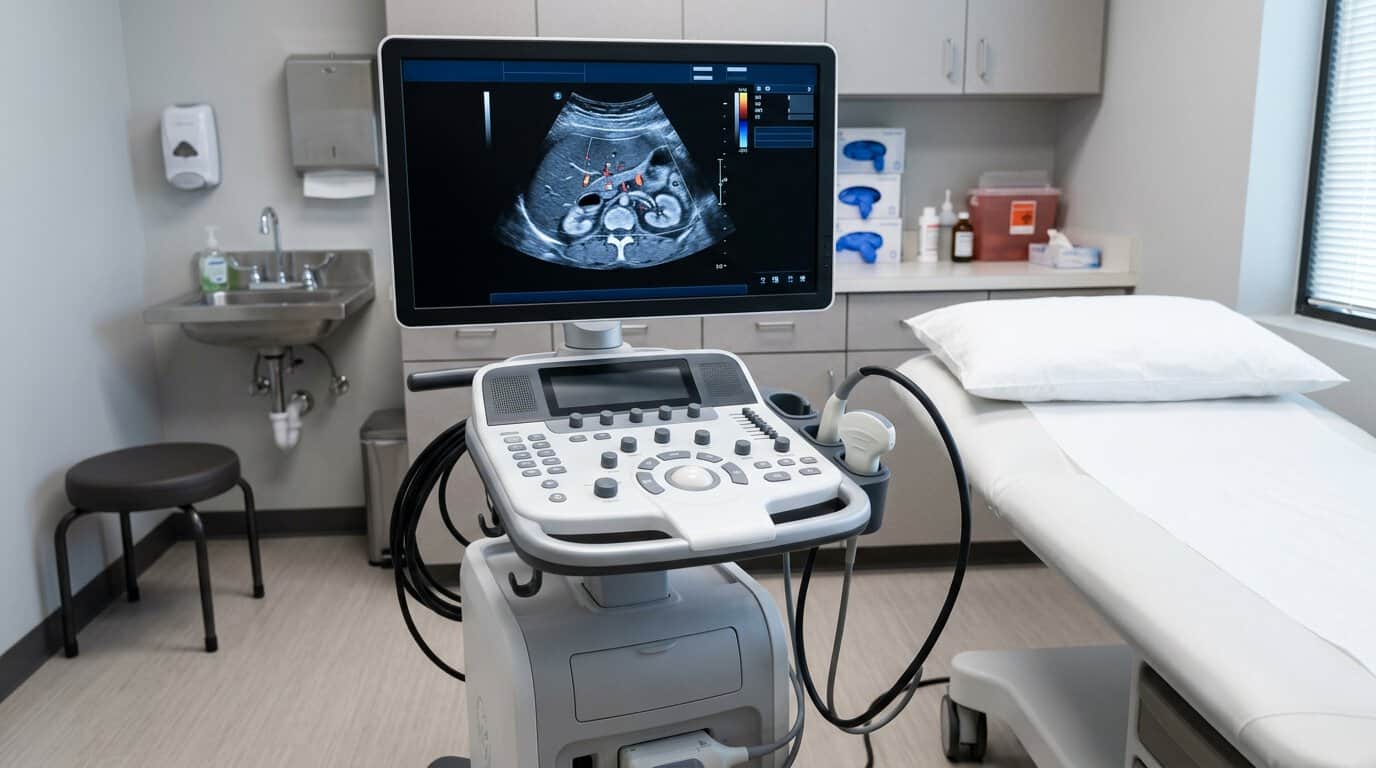
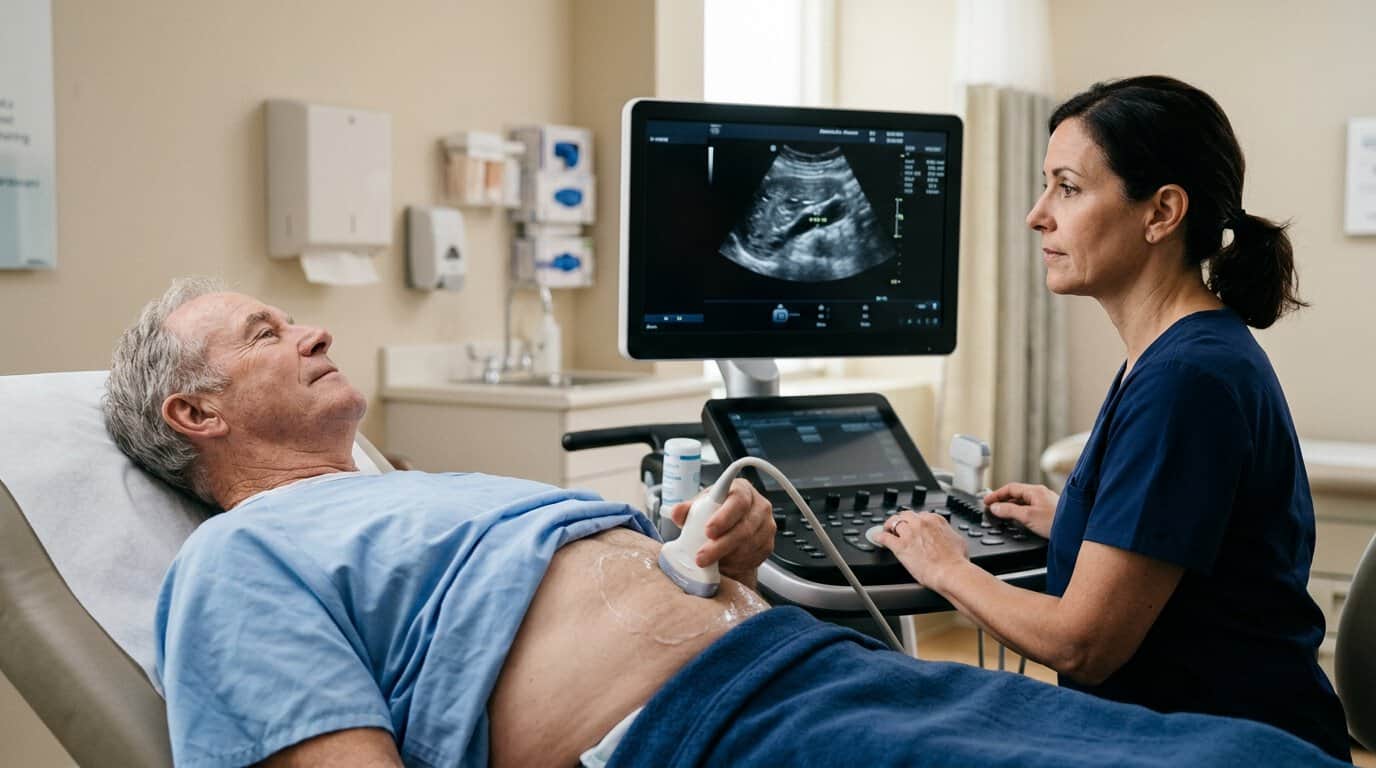
During the scan, a sonographer moves a handheld transducer over your abdomen. Sound waves create live images of the aorta, and the sonographer measures its width at several points along its length. Color Doppler may also be used to look at blood flow. Learn more in what a Doppler ultrasound is and what it detects.
Ultrasound is the standard screening test for AAA. According to the USPSTF, it is noninvasive, simple to perform, uses no radiation, and has high accuracy, with sensitivity of 94% to 100% and specificity of 98% to 100%. CT scans are also accurate, but they are not recommended for screening because of radiation exposure. A physical exam alone misses many aneurysms.
Who Should Be Screened for AAA?
The USPSTF’s current recommendation, published in December 2019, depends on sex, age, smoking history, and family history:
| Group | USPSTF Recommendation | Grade |
|---|---|---|
| Men 65 to 75 who have ever smoked | One-time ultrasound screening is recommended | B |
| Men 65 to 75 who have never smoked | Clinicians should selectively offer screening based on individual risk | C |
| Women 65 to 75 who have ever smoked or have a family history of AAA | Evidence is insufficient to recommend for or against screening | I |
| Women who have never smoked and have no family history of AAA | Routine screening is not recommended | D |
“Ever smoked” usually means smoking 100 or more cigarettes in your lifetime. Some professional groups recommend broader screening. For example, the Society for Vascular Surgery recommends one-time screening for men and women ages 65 to 75 with a history of tobacco use, men 55 or older with a family history of AAA, and women 65 or older who have smoked or have a family history. Talk with your provider about which approach fits you.
How to Prepare for an Aorta Ultrasound
Gas in the bowel can block the view of the aorta, so fasting is usually required. Most patients fast for 6 to 8 hours before an abdominal ultrasound. Follow our fasting prep instructions and any directions you receive when you schedule.
- Ask our team how to handle your regular medications before the exam.
- Wear comfortable, two-piece clothing.
- Bring your referral or imaging order, a photo ID, and your insurance information.
What to Expect During the Exam
You will lie on your back while the sonographer applies warm gel to your abdomen. The sonographer may press firmly to move bowel gas out of the way and may ask you to turn slightly onto your side. The scan is painless, needs no needles or dye, and most patients are finished within about 30 minutes. You can drive home and return to normal activities right away.
Understanding Your AAA Ultrasound Results
A radiologist reviews your images and sends a report to your provider. The most important number on the report is the widest measurement of your abdominal aorta.
| Aorta Width | What It Means | Typical Next Step |
|---|---|---|
| Less than 3.0 cm | Normal. Among men who screen normal, AAA-related death over the next 5 to 12 years is rare (under 3%). | Usually no further screening |
| 3.0 to 3.9 cm | Small AAA. Yearly rupture risk is close to 0%. | Regular ultrasound monitoring |
| 4.0 to 4.9 cm | Medium AAA. Yearly rupture risk is about 1%. | More frequent monitoring and specialist input |
| 5.0 to 5.4 cm | Large AAA. Rupture risk rises; aneurysms of 5.0 to 5.9 cm carry about an 11% yearly risk. | Close monitoring; repair may be considered, especially for women |
| 5.5 cm or larger | Large AAA | Referral for repair is standard practice for men |
Some reports describe an aorta between 2 and 3 cm as “ectatic,” which means mildly widened but not an aneurysm.
Size is not the only factor. Repair is also standard for an aneurysm larger than 4.0 cm that grows 1.0 cm or more in a year. More than 90% of aneurysms found through screening measure between 3.0 and 5.5 cm, so most people with an AAA start with monitoring rather than surgery. Monitoring schedules vary by guideline, so your provider or a vascular specialist will set yours.
When repair is needed, the two main options are endovascular aneurysm repair (EVAR), which is done through small openings in the groin, and open surgery. EVAR is now the most common approach for planned repairs in the United States.
Abdominal Aorta Ultrasound vs. Complete Abdominal Ultrasound
A complete abdominal ultrasound looks at several organs, including the liver, gallbladder, pancreas, spleen, kidneys, and major blood vessels, so it can sometimes reveal an AAA. A dedicated aorta screening focuses on measuring the aorta from top to bottom. Your provider chooses the exam based on your symptoms and risk factors. To learn what a full abdominal exam covers, read what an abdominal ultrasound can diagnose.
Warning Signs of a Ruptured Aneurysm: Call 911
A ruptured AAA is a medical emergency. Call 911 right away for sudden, severe pain in the abdomen, back, or side, especially with dizziness, fainting, clammy skin, a fast heartbeat, or shortness of breath. Do not wait for an ultrasound appointment.
How to Lower Your Risk
- Stop smoking. Smoking is the strongest predictor of AAA, and it is linked to faster growth and higher rupture risk.
- Manage blood pressure and cholesterol with your provider.
- Keep every monitoring appointment if you already have a small aneurysm.
AAA Screening in Fairbanks, AK
Fairbanks Ultrasound is a locally owned imaging center at 570 Riverstone Way, Unit #2, in Fairbanks, Alaska. Our credentialed sonographers perform abdominal and vascular ultrasounds, and radiologists interpret every exam.
- Ask about same-day ultrasound appointments with a valid referral or imaging order.
- Providers can find ordering details on our referring providers page.
Call (907) 374-4644 or request an appointment. We are open Monday through Friday, 8:00 am to 5:00 pm.
Frequently Asked Questions
An abdominal aorta ultrasound is a painless scan that uses sound waves to measure the width of the aorta in your abdomen. It is the standard test for finding an abdominal aortic aneurysm, which is a bulge measuring 3.0 cm or larger.
The USPSTF recommends one-time screening for men ages 65 to 75 who have ever smoked. Men in that age group who have never smoked may be screened based on individual risk. Talk with your provider if you have a family history of AAA.
No. The exam is painless and uses no needles, dye, or radiation. You may feel firm pressure as the sonographer moves gas out of the way, and most patients are finished within about 30 minutes.
Medicare Part B covers a one-time AAA screening ultrasound for people at risk, including those with a family history of AAA and men ages 65 to 75 who have smoked at least 100 cigarettes. A referral is required, and you pay nothing if your provider accepts assignment.
For men, repair is usually recommended when an aneurysm reaches 5.5 cm or grows 1.0 cm or more in a year. Some guidelines suggest repair at 5.0 to 5.4 cm for women. A vascular specialist makes the final recommendation.
Yes, fasting is usually required because gas in the bowel can block the view of the aorta. Most patients fast for 6 to 8 hours. Follow the instructions you receive when you schedule.