

Can an Ultrasound Detect Kidney Damage or Kidney Failure?
Reviewed by the Fairbanks Ultrasound imaging team · Updated October 2026
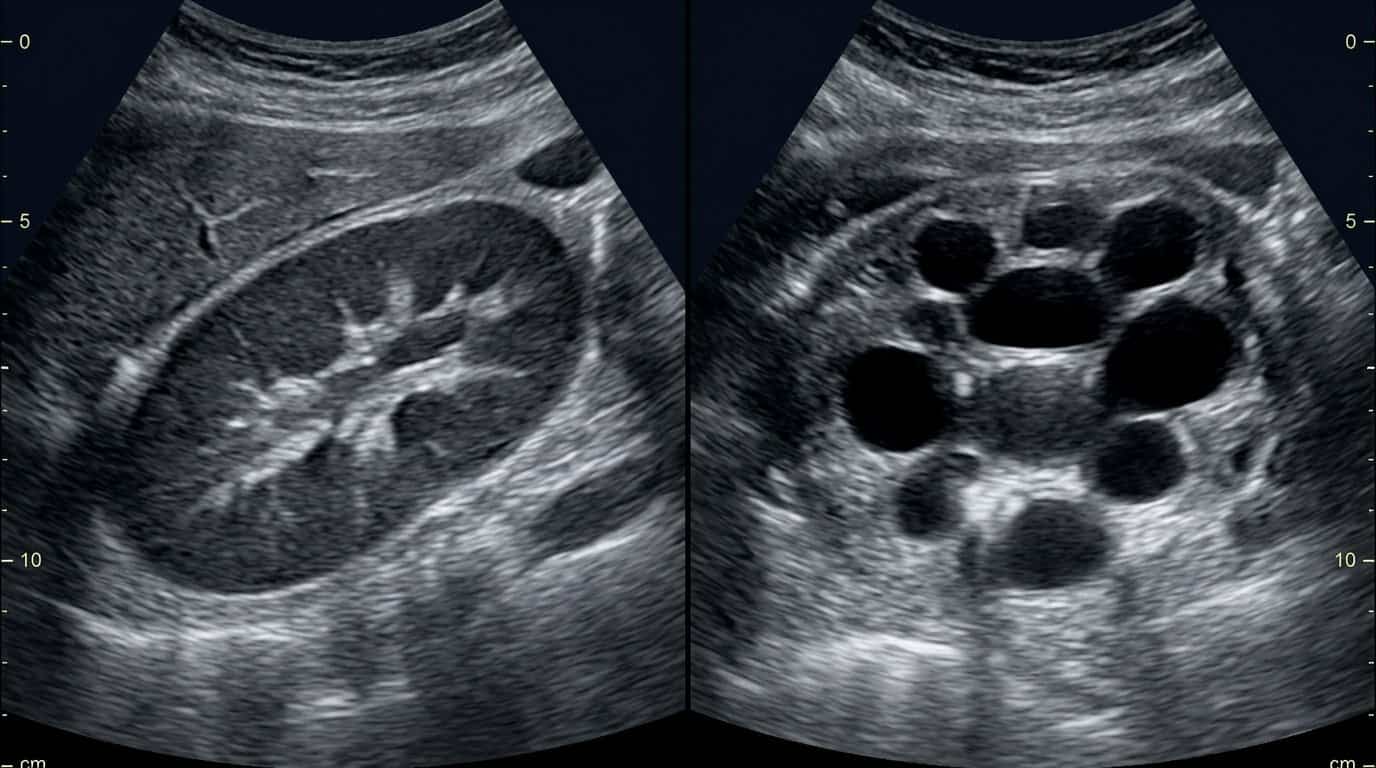
A kidney ultrasound can show signs of kidney damage, such as kidneys that are smaller than normal, thin or unusually bright kidney tissue, scarring, many cysts, or swelling from a blockage. It cannot measure how well your kidneys filter blood, so it cannot diagnose kidney failure on its own. Chronic kidney disease and kidney failure are diagnosed with blood and urine tests, mainly eGFR and urine albumin. Ultrasound helps your provider understand why kidney function has changed and how long the damage has been there.
If you have been referred for a kidney scan, our guide to renal ultrasound in Fairbanks, AK explains the exam step by step. This article focuses on what ultrasound can and cannot tell you about kidney damage.
What Does a Kidney Ultrasound Measure?
A kidney ultrasound, also called a renal ultrasound, uses sound waves to create live images of both kidneys. The radiologist looks at several features:
- Size: Most adult kidneys are about 10 to 12 cm long. Size varies with height, so shorter people tend to have slightly smaller kidneys.
- Symmetry: The two kidneys are usually close in size. A difference of more than about 1.5 cm is considered abnormal.
- Cortex thickness: The cortex is the outer layer of the kidney, where most filtering happens. In healthy adults, it is usually about 7 to 10 mm thick.
- Brightness: A healthy kidney cortex usually looks the same as, or slightly darker than, the liver.
- Drainage: The radiologist checks whether the inner collecting system is swollen with trapped urine.
- Stones, cysts, and masses: These often show up clearly on ultrasound.
- Blood flow: Doppler ultrasound can evaluate blood flow in the kidneys, including the renal arteries.
A complete study of the kidneys and bladder is sometimes called a retroperitoneal ultrasound.
Get in touch with us!
Signs of Kidney Damage on Ultrasound
Small Kidneys
Long-term kidney disease often causes the kidneys to shrink. In adults, a kidney shorter than about 9 cm is a strong sign of chronic damage.
Thin Kidney Tissue
As kidney disease progresses, the cortex often becomes thinner. Cortical thickness tends to decline step by step as kidney function drops.
Brighter-Than-Normal Kidneys
Kidney tissue that looks brighter than the liver is described as “echogenic.” Increased brightness is often linked to scarring from chronic kidney disease, although it can also appear with sudden kidney injury or inflammation.
Scarring and an Uneven Outline
Past kidney infections or reduced blood flow can leave scars that make the kidney’s outline look notched or uneven.
Swelling From a Blockage (Hydronephrosis)
When urine cannot drain normally, the inner part of the kidney swells. This is called hydronephrosis. Common causes include kidney stones and an enlarged prostate. A blockage is important to find because it is often treatable. Read can you see a kidney stone on an ultrasound to learn how stones appear.
Many Cysts
Simple kidney cysts are common and usually harmless. Kidneys that are enlarged and filled with many cysts, however, can point to polycystic kidney disease, an inherited condition that can reduce kidney function over time.
Kidney Ultrasound vs. Blood and Urine Tests
| Test | What It Measures | What It Tells Your Provider |
|---|---|---|
| eGFR (blood test) | How well your kidneys filter blood | The main measure of kidney function, used to stage chronic kidney disease |
| Creatinine and BUN (blood tests) | Waste products in your blood | Rising levels can mean kidney function is dropping; creatinine is used to calculate eGFR |
| Urine albumin (uACR) | Protein leaking into your urine | An early sign of kidney damage; more than 30 mg/g may signal kidney disease |
| Kidney ultrasound | Size, structure, drainage, cysts, stones, and blood flow | Possible causes of kidney damage, how long it has been present, and whether a blockage needs treatment |
Acute Kidney Injury vs. Chronic Kidney Disease on Ultrasound
Acute kidney injury happens over hours or days. On ultrasound, the kidneys are often normal in size and may look swollen or slightly bright. The most important job of the scan in this setting is to check for a blockage, because relieving it can help kidney function recover.
Chronic kidney disease develops over months or years. The kidneys are more likely to look smaller, thinner, and brighter than normal. Together with your lab results, these features help your provider tell a new problem from a long-standing one.
What Causes Kidney Damage?
Diabetes and high blood pressure are the most common causes of chronic kidney disease. Other causes include:
- Blockages from kidney stones or an enlarged prostate
- Polycystic kidney disease
- Repeated kidney infections
- Narrowing of the arteries that supply the kidneys
- Inflammation of the kidney’s filters (glomerulonephritis)
- Some medications that can be hard on the kidneys
Ultrasound can show several of these causes directly, including blockages, cysts, scarring, and, with Doppler, reduced blood flow. Learn more about what a Doppler ultrasound detects.
Why Would a Doctor Order a Kidney Ultrasound?
Your provider may order a kidney ultrasound if you have:
- A drop in eGFR or rising creatinine on blood work
- Protein or blood in your urine
- A sudden decrease in how much you urinate
- Pain in your side or back near the kidneys
- Repeated urinary tract infections
- A family history of polycystic kidney disease
- High blood pressure that is hard to control
- A known kidney condition that needs monitoring
How to Prepare for a Kidney Ultrasound
Preparation depends on what your provider wants to see. You may be asked to arrive with a full bladder, or to fast beforehand to reduce bowel gas. Our team will tell you exactly what to do when you schedule. You can review our full bladder prep instructions and fasting prep instructions ahead of time.
Kidney ultrasound uses no radiation and no contrast dye, so it is safe for people with reduced kidney function. Most exams take 20 to 30 minutes.
What Happens After Your Results?
A board-certified radiologist reviews your images and sends a report to your provider. Depending on what is found, next steps may include repeat blood and urine tests, a referral to a kidney specialist (nephrologist), treatment for a blockage, closer management of blood pressure or diabetes, or a follow-up ultrasound to compare changes over time.
To understand the terms on your report, read normal vs. abnormal kidney ultrasound. For timing, see how long it takes to get ultrasound results.
Kidney Ultrasound in Fairbanks, AK
Fairbanks Ultrasound is a locally owned imaging center at 570 Riverstone Way, Unit #2, in Fairbanks, Alaska. Our credentialed sonographers perform renal ultrasounds close to home, so patients in Interior Alaska can get answers without traveling out of the area.
- Ask about same-day ultrasound appointments with a valid referral or imaging order.
- Paying out of pocket? Review our ultrasound cost without insurance.
- Providers can find ordering details on our referring providers page.
Call (907) 374-4644 or request an appointment. We are open Monday through Friday, 8:00 am to 5:00 pm.
Frequently Asked Questions
Yes. A kidney ultrasound can show signs of damage such as small kidneys, thin or unusually bright kidney tissue, scarring, many cysts, or swelling from a blockage. Blood and urine tests are still needed to measure how well the kidneys work.
Not on its own. Kidney failure is diagnosed with blood tests that measure filtering, mainly eGFR. A GFR of 15 or less is called kidney failure. Ultrasound helps find the cause and shows whether the damage looks long-standing.
A kidney with long-term damage often looks smaller than normal, with a thin outer layer that is brighter than the liver. Scarring can make the outline uneven, and a blocked kidney looks swollen in the center.
Yes. Kidneys can look normal on ultrasound even when blood or urine tests show kidney disease. Some causes, such as diabetic kidney disease, can keep the kidneys normal-sized until later stages.
The eGFR (estimated glomerular filtration rate) blood test is the main measure of kidney function. A GFR below 60 may mean kidney disease, and a GFR of 15 or less is called kidney failure.
Yes. A kidney ultrasound uses sound waves, with no radiation and no contrast dye, so it is safe for people with reduced kidney function.